


As sustainability becomes a high priority factor in manufacturing and regulations continue to tighten worldwide, manufacturers across every sector are not just asking about what their products are made of, but how they are finished. For wood product manufacturers in particular, surface coatings represent both a significant environmental exposure and a meaningful opportunity.
At RDC Coatings, environmental stewardship is built into every custom formulation. Every coating is truly “green” and we make sure that our coating formulations align with the sustainability standards and ESG goals shaping companies today and in the future.
What was Once “Good Enough” in Surface Finishing is Quickly Becoming a Liability – Financially, Operationally & Reputationally.
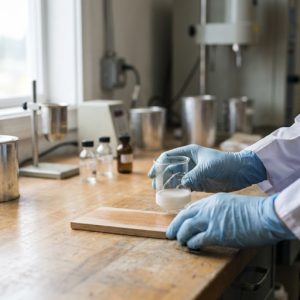
Traditional solvent-borne wood coatings have served manufacturers well for decades — but they come with significant environmental and compliance challenges. These finishes rely on petroleum-derived solvents that evaporate during the curing process, releasing Volatile Organic Compounds (VOCs) into the air. VOCs are a primary contributor to ground-level ozone formation, and prolonged occupational exposure is associated with a range of health risks.
Beyond air quality, conventional thermal-cure systems consume substantial energy. Large gas or electric-powered ovens are required to drive solvent evaporation and cure the coating — a slow, energy-intensive process that adds meaningful cost and carbon to every production run.
For manufacturers facing California Air Resources Board (CARB) regulations, the American Innovation and Manufacturing (AIM) Act, or Proposition 65 compliance requirements, the compliance burden of solvent-borne coatings is also growing. The direction of regulatory travel is clear: stricter limits, broader chemical restrictions, and more rigorous disclosure requirements are coming.
What Makes Wood Coatings Sustainable?
A genuinely sustainable wood coating should meet criteria across several dimensions:
- Chemical safety: No VOCs, no Hazardous Air Pollutants (HAPs), and no per- and polyfluoroalkyl substances (PFAS) — the so-called “forever chemicals” now under intense regulatory and public scrutiny.
- Energy efficiency: Curing processes that minimize energy consumption and avoid the carbon intensity of gas-fired ovens.
- Carbon impact: Reduced Scope 1 and Scope 2 greenhouse gas emissions from both the curing process and the chemistry of the coating itself.
- Durability: A coating that extends product lifespan reduces replacement cycles and the waste associated with them.
- Renewable content: Ingredients derived from biological, renewable feedstocks rather than finite petrochemical sources. This is the newest and fastest-evolving frontier in sustainable coating chemistry.
The Rise of Bio-Based Coating Chemistry
According to BCC Research, the global bio-based coatings market is expected to grow from $13.6 billion in 2025 to $22.6 billion by 2030. Bio-based coatings contain ingredients sourced from renewable biological feedstocks: plant oils, starches, sugars, lignin, and other natural materials. This shift matters for several reasons.
Reducing Dependence on Fossil Feedstocks
Conventional UV and EB curable coating resins are largely derived from petrochemicals. While UV/EB curing is already significantly cleaner than solvent-borne systems, the feedstock origin still represents an embedded carbon cost. Bio-based acrylates and urethane acrylate oligomers derived from castor oil, soybean oil, or sucrose-based polyols can replicate or exceed the performance of their petroleum counterparts while dramatically reducing the fossil carbon embedded in the product.
Supporting Scope 3 Emissions Reduction
As environmental, social and governance (ESG) reporting frameworks increasingly require disclosure of Scope 3 emissions (those embedded in a company’s supply chain), the bio-based content of a coating becomes a quantifiable sustainability asset. Manufacturers who can document that their finishes contain renewable-origin chemistry are better positioned on supplier scorecards and ESG audits.
Alignment with Green Building Standards
Programs such as LEED (Leadership in Energy and Environmental Design), GREENGUARD Certification, and the Living Building Challenge are placing growing emphasis on the chemical and material origin of building products. Wood flooring, cabinetry, and millwork finished with certified low- or no-VOC, bio-based coatings can contribute meaningfully to a project’s green building credits — a tangible commercial differentiator for manufacturers supplying the construction market.
RDC’s Energy-Cured Coating Platforms: Built for Sustainability
RDC Coatings formulates and manufactures custom energy-cured finishes across four primary technology platforms, each of which can be tailored to meet rigorous environmental and performance standards.
Ultraviolet (UV) Curable Coatings
UV curable coatings cure in fractions of a second when exposed to ultraviolet light — eliminating the long oven dwell times and high-energy thermal inputs of conventional systems. RDC’s UV formulations are made to order, matched to the specific UV lamp technology already in use on a customer’s production line. They can be engineered with bio-based chemistry and formulated to achieve zero-VOC status while delivering the hardness, scratch resistance, and chemical resistance required for demanding applications including flooring, cabinetry, and industrial wood components.
Excimer UV Curable Coatings
Excimer UV technology operates at a specific wavelength that cures only the outermost surface layer of the coating — producing a uniquely matte, soft-touch finish without the use of matting agents that can compromise film integrity. These coatings are ideal for premium wood surfaces where a natural, low-gloss aesthetic is desired. Because they cure at room temperature and contain no solvents, they represent a particularly clean option for interior architectural applications where occupant air quality is a concern.
Water-Based Curable Coatings
Water-based coatings substitute water for organic solvents as the primary carrier medium — significantly reducing VOC content and the associated air quality impact. RDC engineers water-based formulations specifically for wood substrates including flooring, cabinetry, and millwork, selecting chemistries that cure quickly and uniformly to support high-throughput manufacturing while meeting the most stringent emissions standards. Water-based systems are often the preferred choice in facilities where solvent handling, storage, and waste disposal create operational complexity.
Electron Beam (EB) Curable Coatings
EB curing uses a beam of accelerated electrons — rather than heat or UV light — to initiate polymerization. Because the process requires no photoinitiators and no heat, EB curable coatings can be formulated with essentially zero VOCs and minimal extractable chemistry, making them among the cleanest finishing options available to wood product manufacturers. The EB curing process also eliminates the need for natural gas or oxidizer systems, directly reducing Scope 1 carbon emissions from the production facility.
Five Measurable Ways Energy-Cured Coatings Improve Your Environmental Footprint
Compared to conventional thermal drying and curing processes, UV and EB curable coatings deliver quantifiable sustainability advantages:
- Energy Savings: Because UV and EB curing occurs at room temperature, energy consumption is at least 50% lower than gas- or electric-powered oven systems — a reduction that shows up directly in Scope 2 emissions and utility costs.
- Lower Greenhouse Gas Emissions: With low or no volatile solvents, UV and EB formulations contribute far less to air pollution and atmospheric greenhouse gas concentrations than solvent-borne alternatives.
- Reduced Carbon Footprint: UV and EB technologies eliminate the need for natural gas combustion (Scope 1) and reduce electricity consumption (Scope 2), supporting measurable progress on corporate carbon reduction targets.
- Smaller Production Footprint: UV and EB systems can cure coatings at higher speeds and in a much smaller space than the square footage required by large, gas- or electric-powered ovens.
- Extended Product Durability: UV and EB cured coatings resist scuffs, scratches, abrasions, and chemical exposure — extending the usable life of finished wood products and reducing the cost of frequent replacement.
Compliance From the Start
Every coating formulated by RDC Coatings is engineered from the start to comply with applicable environmental and safety standards — not retrofitted for compliance after the fact. Customers can be assured that RDC formulations will contain:
- Low or no Volatile Organic Compounds (Low-VOC / Zero-VOC)
- Low or no Hazardous Air Pollutants (HAPs)
- No PFAS (per- and polyfluoroalkyl substances)
RDC’s energy-cured finishes are formulated to satisfy:
- California Air Resources Board (CARB) regulations
- California Proposition 65 requirements
- American Innovation and Manufacturing (AIM) Act compliance
And they meet or exceed performance testing standards set by:
- American National Standards Institute (ANSI)
- Kitchen Cabinet Manufacturers Association (KCMA)
- Scientific Equipment and Furniture Association (SEFA)
A Coating Partner Aligned with Your Environmental Goals
As ESG reporting, green building certifications, and customer sustainability expectations grow, the coating you choose matters beyond performance. It affects your compliance, your supply chain, and your reputation.
RDC Coatings approaches every custom formulation as an opportunity to advance both performance and sustainability — because in today’s market, the two go hand in hand. With bio-based chemistry, zero-VOC formulations, and energy-cured platforms that dramatically reduce the carbon footprint of the finishing process, RDC gives manufacturers a finishing solution they can stand behind — in the plant, in their ESG disclosures, and in the marketplace.
Ready to explore what a custom, eco-engineered coating can do for your product and your environmental performance? Contact RDC Coatings to start the conversation